
Battery rooms play a critical role in industries such as power generation, telecom, data centers, railways, and renewable energy. However, they also pose unique safety challenges. From acid leaks and hydrogen gas emissions to electrical hazards, battery rooms demand infrastructure that’s both safe and durable. This is where FRP Battery Racks come into the picture.
Why Battery Storage Infrastructure Matters
Battery systems are capital-intensive and mission-critical. A minor failure in storage infrastructure can lead to costly downtime, safety incidents, or even regulatory penalties. Traditional materials like steel may look strong, but they often fail in corrosive and electrically sensitive environments. As a result, facility managers are shifting toward advanced composite solutions.
Common Risks in Traditional Battery Racks
Conventional metal racks are prone to corrosion, electrical conductivity, and chemical degradation. Over time, this leads to rust, reduced load-bearing capacity, and increased maintenance. Worse still, metal conducts electricity, increasing the risk of short circuits. These challenges have pushed industries to seek safer alternatives that don’t compromise durability.
What Are FRP Battery Racks?
FRP Battery Racks are basic capacity frameworks made from Fiber Strengthened Plastic, a composite fabric known for its quality, separator, and erosion resistance. They’re particularly planned to bolster mechanical batteries in controlled and cruel situations alike.
Definition and Composition of FRP
FRP combines high-strength strands such as glass filaments with polymer gums like polyester or vinyl ester. This combination comes about in a lightweight however fantastically solid fabric. Not at all like metals, FRP doesn’t erode, rust, or conduct electricity—making it perfect for battery rooms.
Manufacturing Handle Overview
The most common fabricating strategies incorporate pultrusion and molding. Pultrusion guarantees reliable cross-sections and predominant quality, which is basic for rack solidness. Quality-controlled generation guarantees each rack meets stack and security specifications.
Types of FRP Battery Racks
Single-tier FRP battery racks
Multi-tier FRP battery racks
Custom-designed rack for telecom and UPS systems
Each type is engineered to accommodate different battery sizes, weights, and ventilation requirements.
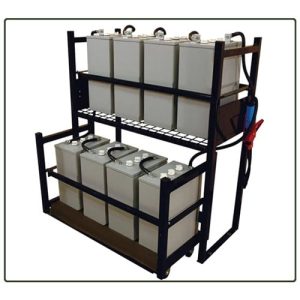
Safety Benefits of FRP Battery Racks
When it comes to safety, FRP Battery Racks clearly outperform traditional alternatives. Their intrinsic material properties reduce multiple risk factors in battery rooms.
Electrical Insulation Properties
FRP is a non-conductive material. This significantly lowers the risk of electrical shock, short circuits, and accidental grounding. In high-voltage battery rooms, this insulation property isn’t just helpful—it’s essential.
Fire Resistance and Flame Retardancy
Modern FRP racks are manufactured using fire-retardant resins. These resins slow flame spread and reduce smoke emission. In the event of a thermal runaway, FRP racks help contain damage rather than amplify it.
Chemical and Acid Resistance
Battery rooms regularly bargain with sulfuric corrosive exhaust and electrolyte spills. FRP stands up to chemical assault, keeping up auxiliary astuteness indeed after drawn out presentation. Concurring to mechanical security rules distributed by OSHA, acid-resistant materials are suggested in battery capacity regions (see OSHA Battery Room Security Rules).
Durability and Long-Term Performance
Durability is another area where FRP Battery Racks shine. While metal deteriorates over time, FRP maintains its performance for decades.
Corrosion Resistance in Harsh Environments
Humidity, acid vapors, and temperature fluctuations can destroy steel racks. FRP, however, remains unaffected. This corrosion resistance ensures stable performance in coastal areas, chemical plants, and industrial zones.
Load-Bearing Capacity and Structural Strength
Despite being lightweight, FRP racks offer impressive load-bearing capabilities. Advanced fiber orientation and resin systems allow them to support heavy battery loads without deformation.
Low Maintenance and Lifecycle Cost
Because FRP doesn’t rust or corrode, maintenance requirements are minimal. There’s no need for repainting or anti-corrosion treatments. Over time, this translates into significant cost savings and a lower total cost of ownership.
Standards, Compliance, and Applications
Adopting FRP Battery Racks isn’t just a smart decision—it’s often a compliant one. Many industries now prefer FRP solutions to meet modern safety standards.
Compliance with Industry Safety Standards
FRP racks are designed to comply with IEC, IEEE, and local electrical safety standards. Their non-conductive and chemical-resistant properties align well with regulatory requirements.
Applications Across Industries
-
Telecom and data centers
-
Power plants and substations
-
Railways and metro systems
-
Solar and renewable energy plants
Their versatility makes them suitable for both indoor and outdoor installations.
Environmental and Sustainability Advantages
FRP has a long service life and requires fewer replacements. This reduces material waste and environmental impact. Many FRP systems are also recyclable, supporting sustainability goals.
Conclusion
In today’s safety-conscious and performance-driven industrial landscape, FRP Battery Rack have emerged as a reliable, future-ready solution. They address critical issues like corrosion, electrical safety, and durability more effectively than traditional materials. With proven advantages in safety, longevity, and cost efficiency, FRP racks are no longer an alternative—they’re the standard for modern battery rooms.
Frequently Asked Questions (FAQs)
1. Why are FRP Battery Racks safer than steel racks?
Because they’re non-conductive, corrosion-resistant, and acid-proof, reducing electrical and chemical risks.
2. Can FRP Battery Racks handle heavy industrial batteries?
Yes, they’re engineered for high load-bearing capacity and structural stability.
3. Are FRP Battery Racks suitable for outdoor use?
Absolutely. They resist UV radiation, moisture, and temperature extremes.
4. How long do FRP Battery Racks last?
With minimal maintenance, they can last 20–30 years or more.
5. Do FRP racks comply with safety standards?
Yes, most are designed to meet IEC, IEEE, and OSHA-related safety guidelines.
6. Are FRP Battery Racks environmentally friendly?
They offer long lifespans and reduced maintenance, lowering overall environmental impact.
Tags: battery room racks, corrosion resistant battery rack, customized FRP battery rack, FRP battery rack for battery room, FRP battery rack India, FRP battery rack manufacturer, FRP battery rack manufacturer India, FRP battery rack supplier, FRP battery racks, FRP battery stand, FRP battery storage rack, heavy duty FRP battery rack, industrial battery rack, non conductive battery rack